
Understanding Enneagram Type Five – The Observer: Navigating the Energy Economy and Finding the Hidden Heart
If you frequently feel the need to retreat from the world to recharge, prefer observing over participating, and possess an intense thirst for specialized knowledge, you might be an Enneagram type Five, commonly known as the Observer or the Investigator.
At their best, Fives are brilliant visionaries, offering profound clarity in crises and deep, analytical wisdom. But behind their calm, detached exterior lies a constant, quiet struggle to protect their limited energy resources from a demanding world.
This in-depth dialogue with iAwake’s CEO John Dupuy and Enneagram teacher Leslie Hershberger, creator of Enneagram Meditations, explores the hidden mechanics of the type Five, the trap of avarice, and the transformational journey out of the head and into the body.
The Five’s Core Fear: The Drain of Energetic Resources
While type Five is in the head/fear triad (along with types Six and Seven), the Five’s specific fear manifests around depletion. The primary question constantly running in the background for a Five is:
Will demands be made on my time? Will demands be made on my energetic resources?
Because they feel their internal battery is inherently limited, Fives navigate the world with a highly defensive energy economy. As Leslie notes, a Five will walk into a party and immediately scan the room with a radar for the “hugger”—or anyone else who looks like they might want to extract emotional energy. To protect themselves, Fives hide behind the veil of the mind, retreating into intellect to maintain their boundaries.

The Passion of Avarice
The emotional passion (or vice) of the type Five is avarice. In the Enneagram, this rarely means greed for money. For the Five, avarice often involves the hoarding of time, energy, space, and information. The underlying belief is:
There’s never enough for me… So I have to contain it all.
A “castle Five” retreats into their meticulously organized home, hoarding niche collections (like specialized anthropology books or fine wines) and compartmentalizing their friendships so that no single group demands too much of them at once. They build massive intellectual frameworks—sometimes subscribing to grand “theories of everything”—just to make the unpredictable, messy world feel safe and manageable.
The Hidden Heart: Feeling Emotions in Solitude
Because Fives often present with a monotone, detached demeanor, others might mistakenly assume they are “dead from the neck down.” This is a profound misunderstanding. Fives have deep access to their hearts, but the external world simply feels too overwhelming to process those emotions in real-time.
The affective piece is done alone… I know how I feel about you when I’m alone.
A Five might avoid a messy emotional conflict in person, only to retreat to their room and write a breathtakingly beautiful, heartfelt letter. If you are in a relationship with a type Five, the greatest gift you can give them is advance notice. Give them the topic of a difficult conversation ahead of time so they can process it cognitively first, allowing their heart to catch up in a safe way.
The Danger Zone: Dissociation and Frenetic Escapism
When a type Five becomes deeply unhealthy, their detachment turns into full dissociation (the classic example given is Howard Hughes). They may sever ties with the physical world entirely.
Under everyday stress, a Five disintegrates toward type Seven (the Enthusiast). They lose their focused containment and become scattered and frenetic. Spending too much time purely in the mind—such as hours trapped behind a computer screen—generates an unsettling, kinetic anxiety.
Sometimes alcohol or substances are used by Fives specifically to bypass their rigid mental defenses. In cases of intense grief, a Five might use a substance to force a softening of the heart; now they can break through their natural containment and cry.
Enneagram Meditations for the Five: Moving From Head to Body
The path to integration and health for the Observer involves moving toward the high side of the type 8 (the Challenger). To grow, a Five must literally get out of their head (they are often referred to as being a “head on a stick”) and drop down into their physical body to access their personal power.
I find a lot of fives like doing Tai Chi or Qigong or something like that where they can move in and feel their bodies, feel their power.
Meditations for Enneagram type Five shouldn’t just be more cognitive exercises. They need somatic (body-based) practices. Furthermore, a Five’s spiritual growth often hinges on embracing the unknown. When the limits of knowing are reached, true wisdom is found in surrendering the need to intellectually account for every detail and simply resting in present-moment awareness.
Ready to Step Out of Your Mind and Into Your Life?
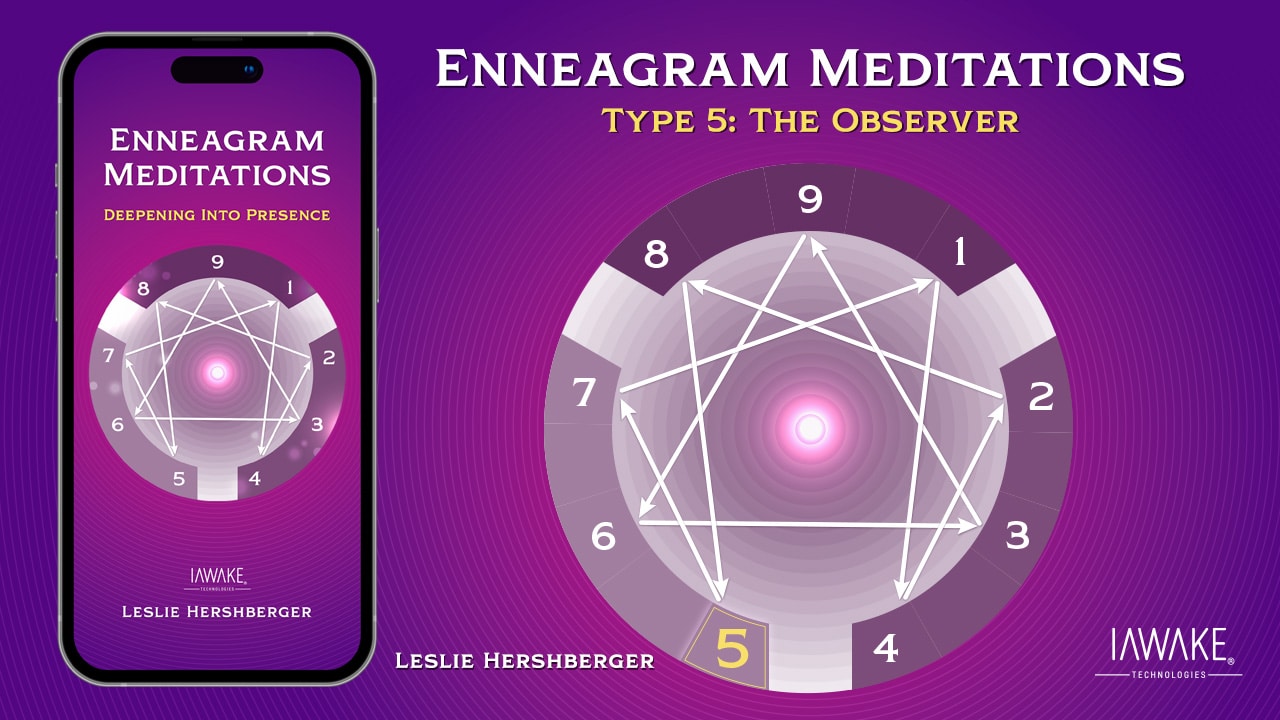
If you are a type Five, your intellect is a profound gift. But your mind is only one third of your true intelligence. If you are exhausted by the constant need to hoard your energy or if you feel disconnected from your own physical presence, it is time to safely bridge the gap between your head and your body.
You don’t have to surrender your boundaries to engage with the world. We have developed specialized tools designed to help you safely ground your awareness and connect with your physical power.
Transform Your Inner World with iAwake’s Enneagram Meditations
These tracks are specifically engineered to help you:
- Ground in the body: Safely move your energy down from frenetic mind into the grounded stability of your physical center.
- Release energetic hoarding: Cultivate a mindset of abundance, realizing that your energy replenishes naturally when you allow it to flow.
- Embrace the unknown: Find deep peace when the limits of intellectual knowing have been reached.
Stop analyzing life from a distance—safely step in. Discover the power of targeted meditations for Enneagram type Five and start your journey towards embodied presence today.

Teacher, theologian, spiritual guide, and master facilitator, Leslie Hershberger is the founder of The Three-Centered Enneagram, and offers both corporate and contemplative workshops, retreats, and keynotes throughout the U.S. and in Europe. She designed the online course The Foundations of the Enneagram: The Centers Approach, which is both a deep and a practical way of developing embodied emotional and social intelligence. Leslie integrates the Enneagram, three-centered contemplative practice, and Integral Theory in her work.

John Dupuy is a co-founder of iAwake® Technologies, co-host of the Deep Transformation: Self-Society-Spirit podcast, and founder of Integral Recovery®. His book, Integral Recovery: A Revolutionary Approach to the Treatment of Alcoholism and Addiction, won the 2013 USA Best Book Award. John travels internationally to teach and inspire on the subjects of Integral Recovery, Integral Transformative Practice, and the use of brainwave entrainment technology to deepen one’s meditation practice and in the treatment of addiction, depression, and PTSD.

Leave a Comment
You must be logged in to post a comment.
Leave your comments below